Complete Guide: How to Register an LLC in Moldova in 2026
How to register an LLC in Moldova: required documents, steps, costs from 2,000 MDL, ~3-day timeline, share capital, and tax advantages. Full company formation guide.
 DeschideCompanie
 The ten banks licensed by the NBM, which ones are systemically important, what SEPA membership changed for company euro payments, and how to pick your bank.
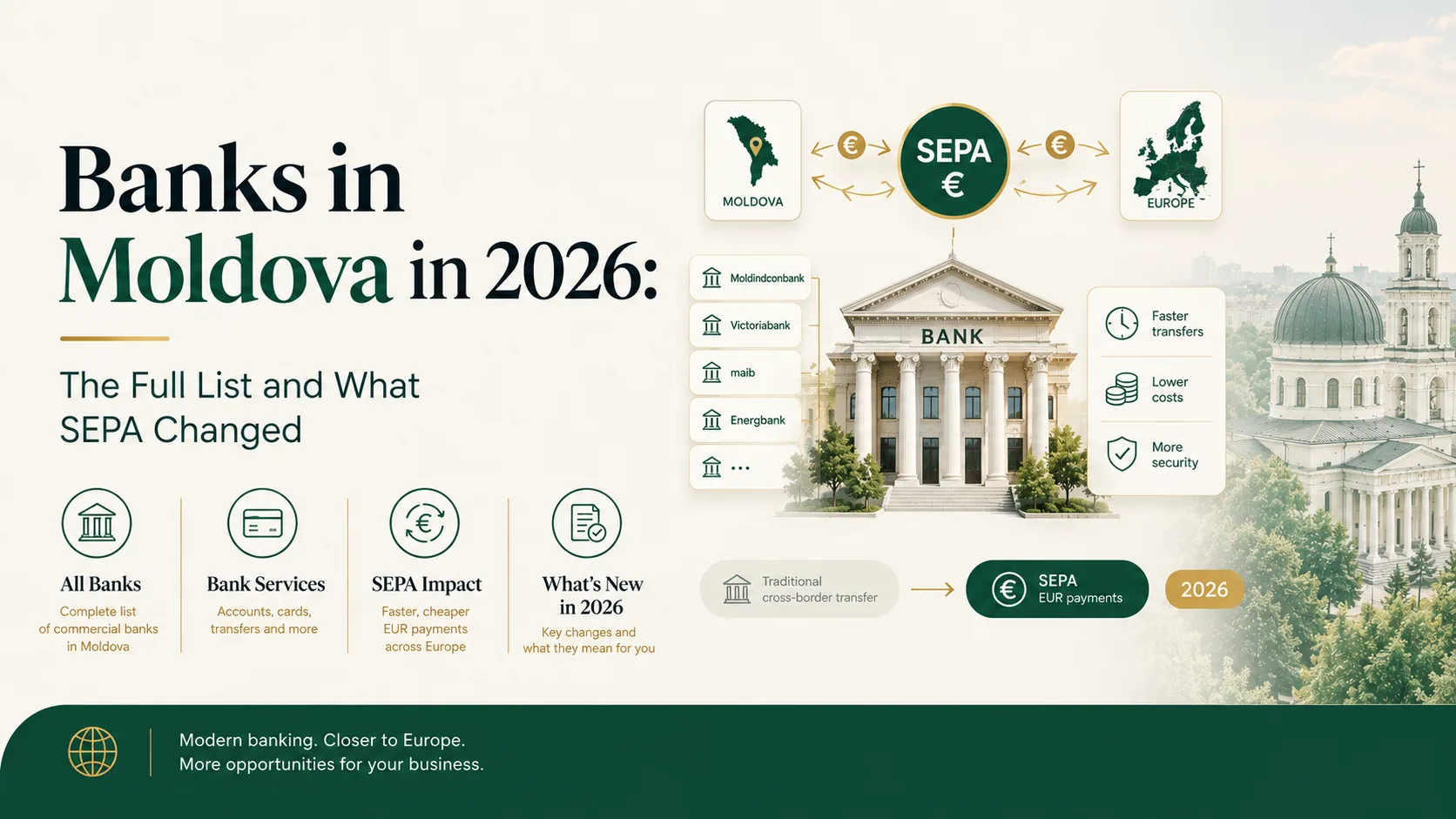
The first question a founder asks once the registration certificate is in hand is not “what does the account cost”. It is “which bank”. And it is a good question, because in Moldova it can be answered in full.
There are ten licensed banks in the entire country, all supervised by the same central bank under the same rules. You can go through every one of them in an afternoon and know exactly where you are heading before you file anything — a luxury a market with three hundred banks does not give you. And since October 2025 this system has been running euro payments to the same standards as banks inside the European Union. That is the most important thing that has happened to a Moldovan company invoicing abroad.
The official list is kept by the National Bank of Moldova and it is the only one that counts — a bank may operate in Moldova only under an NBM licence. As it stands, the NBM register holds ten banks:
One detail that is easy to miss: the list holds banks, not branches. Each one has its own licence, its own board and its own compliance policies, which means each one also has its specialities — client profiles it serves particularly well. That is where the whole advantage of an informed choice comes from: the same company takes different paths at different banks, and one of those paths is the fast one.
Every year the NBM identifies the systemically important banks — those that matter most to the financial system. The status brings higher capital requirements and closer supervision, which is an extra margin of safety for the money held there.
By Executive Board decision no. 85 of 8 April 2026, published in the Official Gazette no. 170-172 of 16 April 2026, four banks were identified as systemically important: MAIB, Moldindconbank, OTP Bank and Victoriabank.
For a founder this translates simply: these are the most closely supervised banks in the system and the ones holding the most capital against the risks they take.
This is the part foreign investors ask about most often, because it changes how the account looks to a partner in the European Union.
Eximbank was bought by the Italian group Intesa Sanpaolo, a transaction also announced by the NBM. Victoriabank is controlled by Banca Transilvania together with the EBRD, which jointly took the majority stake in 2018. ProCredit Bank belongs to the German group ProCredit Holding, and OTP Bank is part of the Hungarian OTP group. At MAIB, the controlling stake is held by the HEIM Partners consortium, made up of the EBRD, Invalda INVL and Horizon Capital.
A substantial part of the Moldovan banking system is therefore aligned with European governance standards, because the shareholders answer to EU regulators. It shows in practice: the documents requested when you open an account are exactly the ones a partner or an auditor in the European Union already expects, and a properly prepared file goes through without surprises.
This is the real news of the past two years.
SEPA — the Single Euro Payments Area — is the system under which a euro transfer between two member countries happens on the same terms as a domestic payment. Moldova entered the geographical scope of the SEPA schemes on 6 March 2025, and on 6 October 2025 it connected operationally. On that date, eight Moldovan commercial banks had already obtained SEPA Participant status.
The results are not projections, they are measured. Ten months after the connection, the NBM published the balance sheet:
| Indicator | Result after 10 months of SEPA |
|---|---|
| Share of euro transactions processed through SEPA | 8 out of 10 |
| Average cost of a transfer | from EUR 20–150 down to EUR 1.09 |
| Total savings for citizens and businesses | EUR 13.2 million |
| Value of transfers, against the preceding period | from EUR 9.3 to EUR 14.6 billion (+57%) |
| Transfers processed since connection | around 960,000 |
The EUR 1.09 figure is a system-wide average calculated by the central bank; specific terms are confirmed with your bank.
What matters to a company selling abroad is the day-to-day effect. A euro transfer to a client or a supplier in the European Union now runs on the same infrastructure as a payment from Germany to France, with the same timelines and the same standards. The NBM puts it directly: SEPA “removes administrative barriers and brings Moldovan companies onto an equal footing with European ones”. In an economy where around 60% of exports go to the EU, the advantage shows up every month, on every invoice collected.
The guarantee covers legal entities too, which many founders only discover after the account is open.
Law no. 160/2023 on deposit guarantee in banks came into force on 1 October 2023 and covers the deposits of individuals and legal entities alike, resident and non-resident. The coverage level administered by the Deposit Guarantee Fund in the Banking System is 200,000 lei as of 1 January 2025, double the previous threshold. The amount applies per depositor and per bank, regardless of the number of accounts or the currency they are held in — a company with accounts at two banks is covered at each of them.
Banks differ mainly in the client profiles they serve best, and getting the match right the first time is what gets you your IBAN fastest.
Worth checking, in this order:
The account is opened after the company is registered: a business account belongs to the company, and the application needs the registration certificate and the IDNO code. That is why we prepare the bank in parallel with the registration file, so there is no gap between the two.
Our bank account opening service covers the whole route: we pick the bank that fits your activity, your currencies and your ownership structure, prepare the complete file and the business description in the form the compliance department expects, handle the correspondence with the bank and, where the bank allows it, appear on your behalf under a power of attorney. For foreign founders we add the IDNP and the notarised power of attorney, and if you invoice in euro inside the EU we pick a SEPA Participant bank from the start. The result is a working IBAN and a multi-currency account you can collect and pay from.
We also work the full chain if the company is not registered yet: legal form, constitutive documents, CAEM codes, registered address, filing with the Public Services Agency, the bank account and the accounting that follows.
The concrete steps for opening the account and the documents banks require are set out in our bank account guide for non-residents. If you do not have the company yet, start with registering as a foreign founder. If your activity is IT or R&D, look at the 7% IT Park regime as well, which pairs naturally with a multi-currency account. All services, with prices, are on the corporate services page.
Write to us with what your business does, where you collect from and who the beneficial owners are, and we will tell you which of the ten banks gives you the best odds and what your file needs to contain before you submit it.
The list of licensed banks, the systemic importance status and the SEPA figures come from the National Bank of Moldova, and the deposit guarantee level under Law no. 160/2023 from the Deposit Guarantee Fund in the Banking System. All of them are linked in the text and verified as of this date. The composition of the list can change, and SEPA Participant status is granted bank by bank, over time.
Ten. The National Bank of Moldova keeps the register of licensed banks and updates it whenever anything changes: COMERȚBANK, ENERGBANK, EuroCreditBank, EXIMBANK, Moldindconbank, MOLDOVA-AGROINDBANK, ProCredit Bank, VICTORIABANK, Banca de Finanțe și Comerț and OTP Bank.
That a euro transfer between a Moldovan bank and a bank in a SEPA country follows the same rules as a domestic payment inside the European Union. Moldova entered the geographical scope of the SEPA schemes on 6 March 2025 and connected operationally on 6 October 2025. The leu remains the national currency — SEPA concerns euro payments only.
SEPA Participant status is obtained bank by bank. Eight commercial banks already held it when Moldova connected operationally, and the list keeps growing. If you invoice in euro inside the European Union, we pick a participant bank for you from the start.
Yes, including those of legal entities. Law no. 160/2023 covers deposits of both individuals and legal entities, resident and non-resident, and the coverage level is 200,000 lei as of 1 January 2025. The amount applies per depositor and per bank, regardless of the number of accounts or the currency.
They are the banks that matter most to the financial system, which the NBM requires to hold an additional capital buffer and supervises more closely. For 2026 there are four: MAIB, Moldindconbank, OTP Bank and Victoriabank.
It depends on your business profile: what you actually do, the currencies you get paid in, your ownership structure and whether you need SEPA transfers. Each bank serves certain profiles particularly well, and getting the match right the first time is what gets you your IBAN fastest.
Yes. We pick the bank that fits your activity and structure, prepare the file and the business description the compliance department expects, and handle the correspondence with the bank. Where the bank allows it, we act for you under a power of attorney.
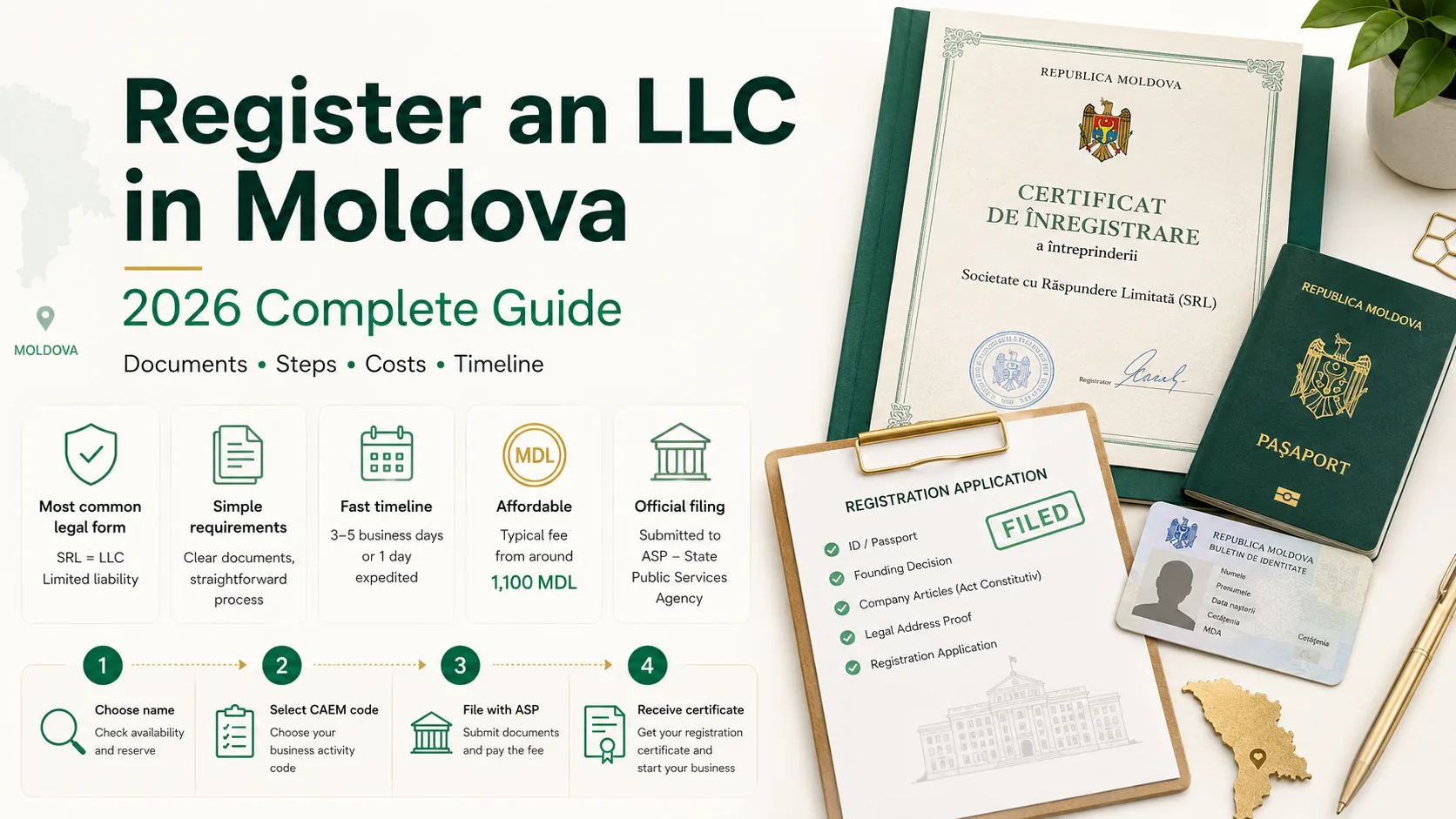
How to register an LLC in Moldova: required documents, steps, costs from 2,000 MDL, ~3-day timeline, share capital, and tax advantages. Full company formation guide.
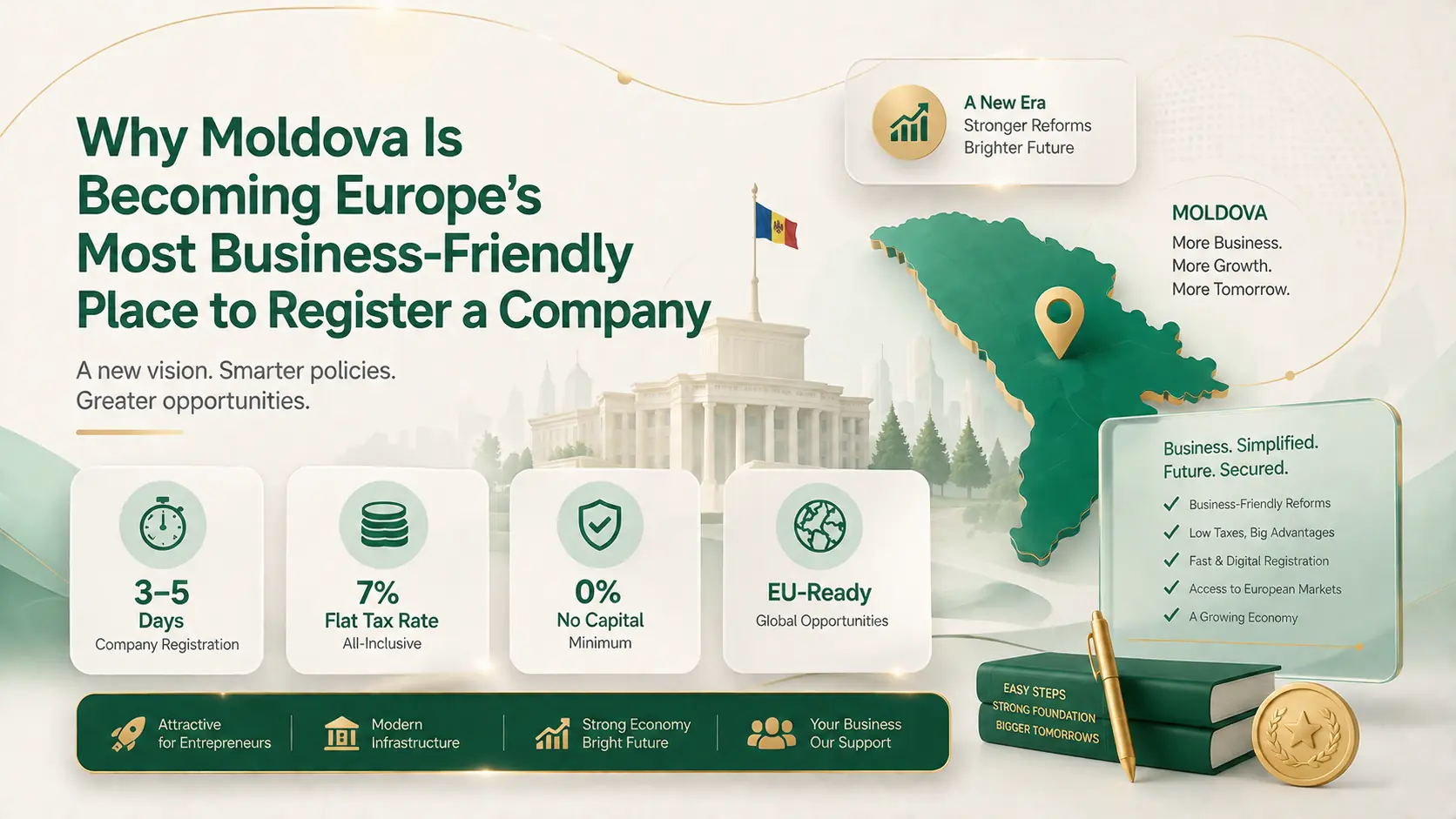
What Moldova's 2026 'European Economy, Efficient State' reform plan changes for registering a company — and why it is already a fast, remote-friendly place to start.
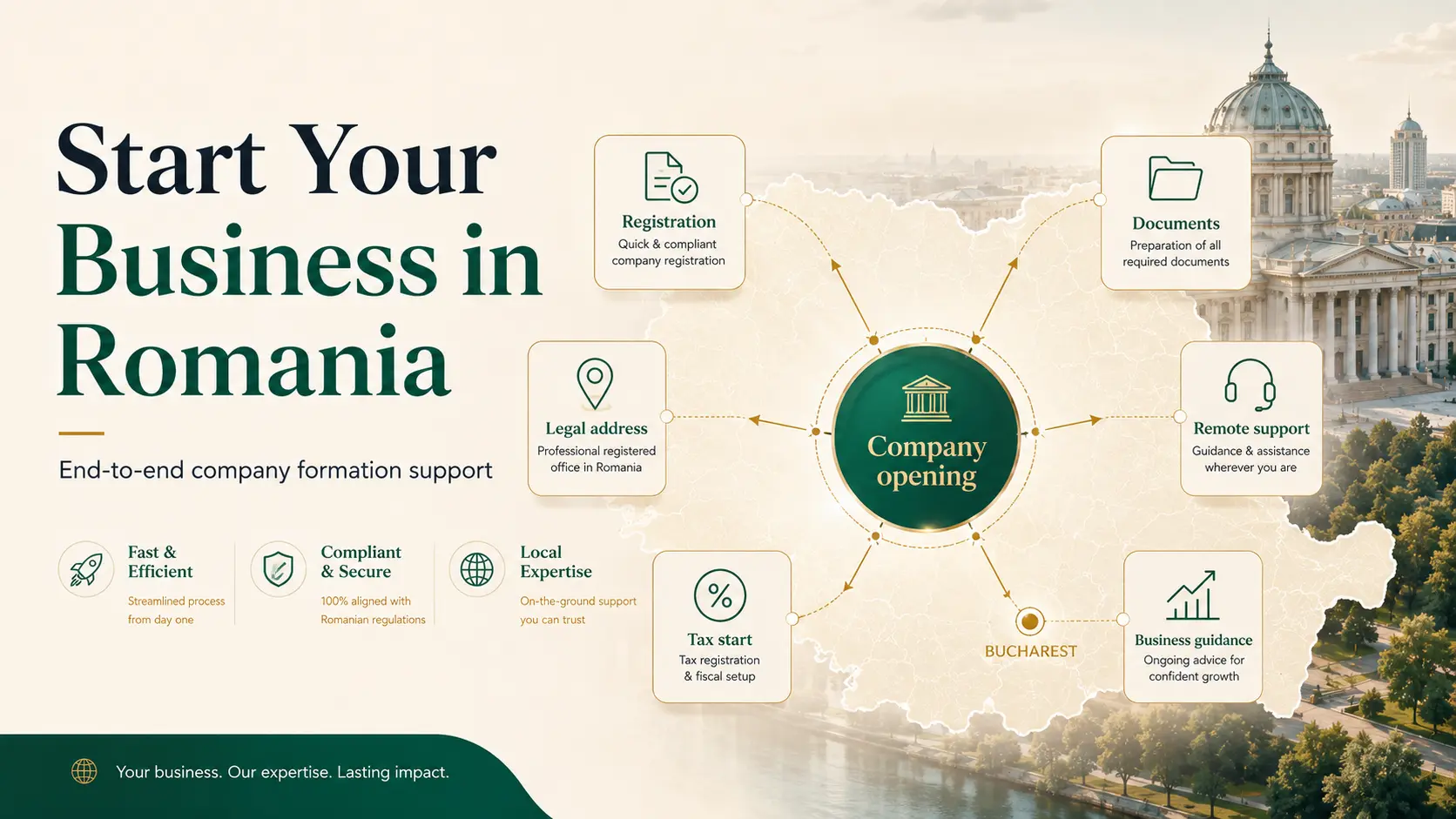
What a Romanian company actually adds, which reasons stopped being true in 2026, and what an SRL costs — whether you are starting out or already trading.