Complete Guide: How to Register an LLC in Moldova in 2026
How to register an LLC in Moldova: required documents, steps, costs from 2,000 MDL, ~3-day timeline, share capital, and tax advantages. Full company formation guide.
 DeschideCompanie
 You don't need a pharmacy degree to own one in Moldova. Who must run it, what a village pharmacy needs, and who may run mobile units and vending machines.
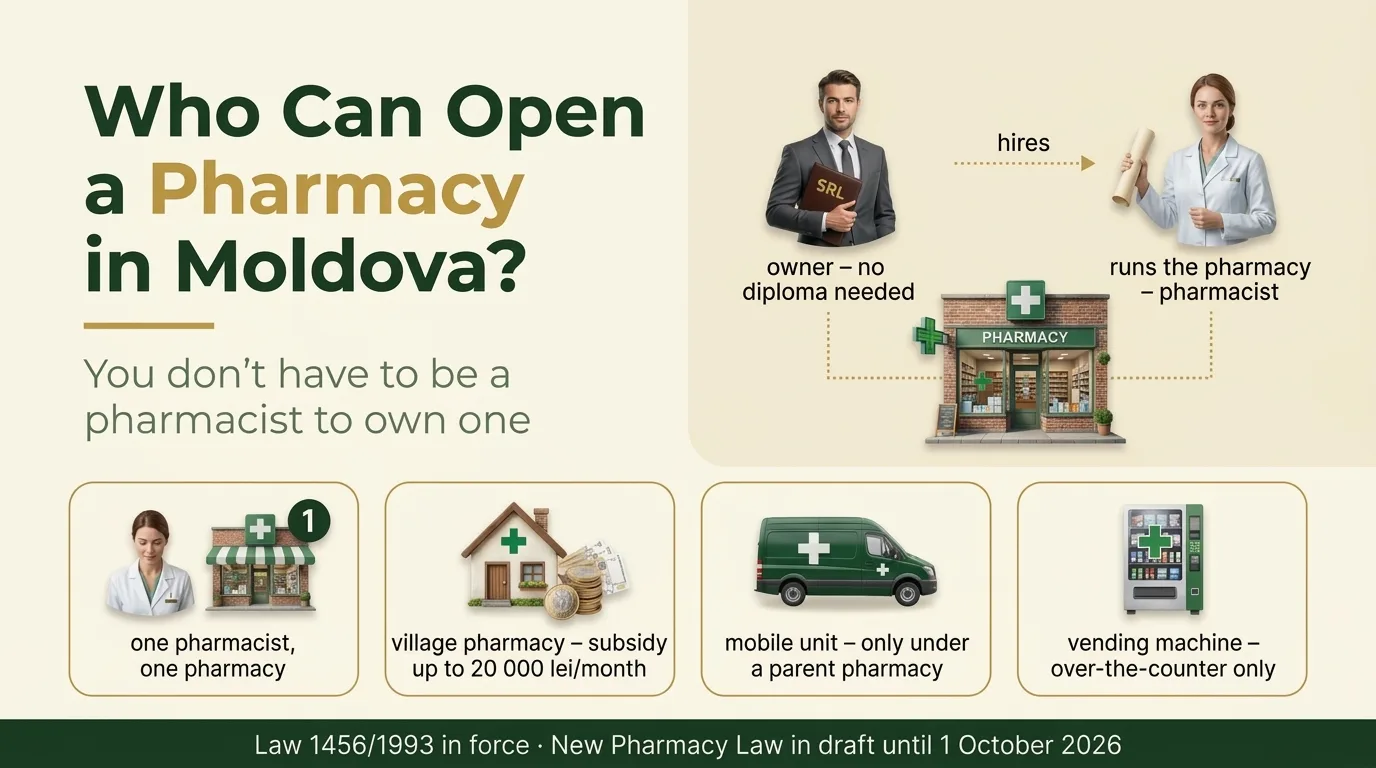
Who can open a pharmacy in Moldova? The question comes up every time someone looks at a pharmacy as a business, and it usually sounds like this: do you have to be a pharmacist to open one? No. The owner can be anyone, including a foreign investor. The state asks for a diploma from the person who runs the pharmacy and from the people who dispense the medicines.
Below is how things stand today, what the state asks of a subsidised village pharmacy, and who will be allowed to run the mobile units and medicine vending machines in the draft of the new Pharmacy Law.
Law no. 1456/1993 on pharmaceutical activity says pharmaceutical enterprises can be state-owned, private or in mixed ownership, and the state guarantees them equal operating conditions. No rule reserves pharmacies for pharmacists.
The licence file shows this best. At the Medicines and Medical Devices Agency (AMDM) you submit the company’s application, the deed or lease for the premises, the pharmaceutical diplomas of the staff, the continuing education certificate and the appointment orders of the heads of the pharmacy and its branches. The owner’s diploma appears nowhere. As a rule, a pharmacy is opened as an LLC (SRL), and its shareholders can be doctors, pharmacists, businesspeople or companies from abroad.
A foreign investor can hold the company’s entire capital and register it remotely, by power of attorney. The steps are in our guide for foreign founders.
The professional requirement sits with the head of the pharmacy. The law says pharmacies, their branches and pharmaceutical warehouses may be headed only by pharmacists. Villages get one exception: a pharmacy or branch there can be headed by a pharmacy technician (laborant-farmacist) with the qualification the Ministry of Health requires.
One more rule matters to anyone planning more than one pharmacy: a pharmacist may head only one pharmaceutical unit. Put them in charge of two and you risk losing the licence, because the law treats heading several units at once as a separate breach. A chain of four pharmacies therefore needs four heads, not one who does the rounds.
Foreign pharmacists can work on the same terms as Moldovan ones once their diploma has been recognised as equivalent.
| Role | Who can hold it | What the law asks |
|---|---|---|
| Pharmacy owner | Any person or company, from Moldova or abroad | No diploma |
| Head of a town pharmacy | Pharmacist | Pharmacy degree and continuing education; heads a single pharmacy |
| Head of a village pharmacy | Pharmacist or pharmacy technician | The qualification set by the Ministry of Health |
| Staff who dispense medicines | Specialists with higher or secondary pharmaceutical education | Diploma, recognised as equivalent if obtained abroad |
| Staff of a subsidised village pharmacy | Also graduates of medical colleges or of the University of Medicine and Pharmacy | Medical diploma, recognised as equivalent if obtained abroad |
Villages with no pharmacy have a separate regime, set by Government Decision no. 1036/2023. Here the company applies, not an individual: the subsidy goes to a legal entity registered in Moldova. The differences from an ordinary pharmacy are large.
The licence is issued free of charge, for five years. Medicines may also be dispensed by specialists with a medical education, not only a pharmaceutical one: graduates of medical colleges and of the Nicolae Testemițanu State University of Medicine and Pharmacy. The premises must have at least 15 m², not counting the hallway and toilet, and the pharmacy is open at least six hours a day and holds a contract with the National Health Insurance Company for reimbursed medicines.
The subsidy is paid quarterly and depends on average monthly sales excluding VAT:
| Average monthly sales, excluding VAT | Monthly subsidy |
|---|---|
| up to 50,000 lei | 20,000 lei |
| up to 100,000 lei | 15,000 lei |
| up to 150,000 lei | 10,000 lei |
If sales in a quarter exceed 450,000 lei, no subsidy is paid for that quarter. The contract with AMDM is signed for five years.
AMDM publishes a monthly list of villages where it is looking for a pharmacy. If one application comes in for a village, the agency decides on the file. If two or more come in, it holds a reverse auction: it starts at 20,000 lei and goes down in steps of 500 lei, and the company that accepts the lowest subsidy wins. After the decision you have six months to obtain the licence, or you lose the right to the subsidy. That is why the company has to exist before you apply: the extract from the state register of legal entities is the first document in the file.
Today’s law provides for neither mobile pharmacies nor medicine vending machines, so nobody can open one today. Both appear in the draft of the new Pharmacy Law, no. 151/MS/AMDM/2025, which is in public consultation on particip.gov.md until 1 October 2026. What the draft changes for chains and for the 250-metre rule is covered in our article on Moldova’s new Pharmacy Law. Here the only question is who will be allowed to operate them.
The short answer is that neither can be a stand-alone business. A mobile unit and a vending machine operate only under an authorised “parent” community pharmacy, which provides all the pharmaceutical services and carries professional responsibility for them. Each must be entered in the annex to that pharmacy’s authorisation, with a coordinating pharmacist named. Anyone who wants a fleet of mobile pharmacies must therefore have a real pharmacy first.
The owner, though, stays as free as today. The draft adds no education requirement for the founder and does not reserve pharmacies for pharmacists. Any operator who meets the conditions can apply for the authorisation, and for villages with no pharmacy the draft provides a fast track open to any company, whatever the size of its chain: the application is examined within 15 working days, with no fee, and if the authority is late, tacit approval applies.
The conditions proposed for each form:
| Unit | Where it can operate | Who staffs it | Limits |
|---|---|---|---|
| ”Parent” community pharmacy | Anywhere, with no minimum distances | Headed by a pharmacist in charge | Answers for every unit under it |
| Pharmaceutical point | Village | Pharmacy assistant or retrained health worker | Coordinating pharmacist present at least two days a week |
| Mobile pharmacy unit | Only villages with no pharmacy, branch or pharmaceutical point | Pharmacist, pharmacy assistant or retrained health worker | No narcotic or psychotropic medicines, no compounding; three-year pilot |
| Medicine vending machine | Villages or isolated areas with no pharmacy and no pharmaceutical point | Supervised by the coordinating pharmacist | Over-the-counter medicines only, from the minister’s list; three-year pilot |
The draft also creates a new occupation in villages. Nurses and other health workers can complete a nationally certified retraining programme and then work in pharmaceutical points, rural branch pharmacies and mobile units. They cannot head a parent pharmacy, though, and cannot compound medicines. Management stays with the pharmacist.
Online sales also stay with pharmacies. Any authorised community pharmacy can sell online through its own website or platform, and marketplace-type platforms with no authorised pharmacy behind them are banned. Delivery companies can, however, carry medicines from the pharmacy to the patient.
The draft is not going through unopposed. Its critics include a former Health Minister, who argues that mobile units and vending machines weaken the pharmacist’s control over how medicines are dispensed. The Ministry replies that the coordinating pharmacist remains responsible for every unit and that in villages the real alternative is often no pharmacy at all.
It is not the first attempt. In December 2020 Parliament passed Laws no. 236 and no. 240, which introduced mobile pharmacies and home delivery of reimbursed medicines. In Judgment no. 8 of 11 March 2021 the Constitutional Court declared them unconstitutional, because they had been adopted without the Government’s opinion on their budget impact. The Court ruled on the procedure, not on the idea of a mobile pharmacy. This time the draft comes from the Ministry of Health itself and goes through the Government before Parliament.
For an investor the conclusion is simple: the text can still change, and mobile units and vending machines start as a three-year pilot. A business plan can include them, but it should start from a pharmacy that works under today’s rules.
The order is the same whether you are aiming at a pharmacy in town, a subsidised one in a village or, later, a chain with mobile units: company first, then the pharmacist who will run it, then the licence. The licence fee is halved if the company is no more than a year old when you apply, and for the village subsidy the register extract is the first document required. The licence, the notifications and the CAEM codes are explained on our page about how to open a pharmacy in Moldova.
We set the company up so you can apply for the licence or the subsidy straight away: the right legal form, usually an LLC (SRL), the founding documents, the CAEM code for retail sale of pharmaceutical products, a registered address, filing with the Public Services Agency, the bank account and, if the director comes from abroad, the IDNP personal number. Registration takes about three working days, and our services and prices are on the corporate services page.
Write to us with where you want to open the pharmacy, whether you already have the pharmacist who will run it and whether you are investing from abroad, and we will tell you which documents you need for the company and for the licence.
Yes. Law no. 1456/1993 allows private pharmacies, and at licensing the Medicines and Medical Devices Agency asks for the diplomas of the people who work in the pharmacy and the appointment order of its head, not the owner's diploma. The condition is that you employ a pharmacist to run the pharmacy.
Only one. The law says a pharmacist or a pharmacy technician may head only one pharmaceutical unit, and heading several at once is grounds for withdrawing the licence. A chain of three pharmacies needs three heads.
Yes. The owner of the LLC (SRL) can be a foreign citizen holding 100% of the capital, and the company can even be registered by power of attorney. A foreign pharmacist can work in the pharmacy once their diploma has been recognised as equivalent in Moldova.
Nobody yet, because today's law does not provide for them. Under the draft of the new Pharmacy Law, only an authorised community pharmacy, called the "parent" pharmacy, will be able to have them, and it answers for them. They will not be allowed to open as a separate business.
Between 10,000 and 20,000 lei a month, depending on sales: 20,000 lei at average monthly sales of up to 50,000 lei excluding VAT, 15,000 up to 100,000 and 10,000 up to 150,000. The licence for a subsidised pharmacy is issued free of charge, for five years.
The Constitutional Court declared Laws no. 236 and no. 240 of 16 December 2020 unconstitutional in Judgment no. 8 of 11 March 2021, because they had been passed without the Government's opinion on their budget impact. The Court did not rule on mobile pharmacies as an idea.
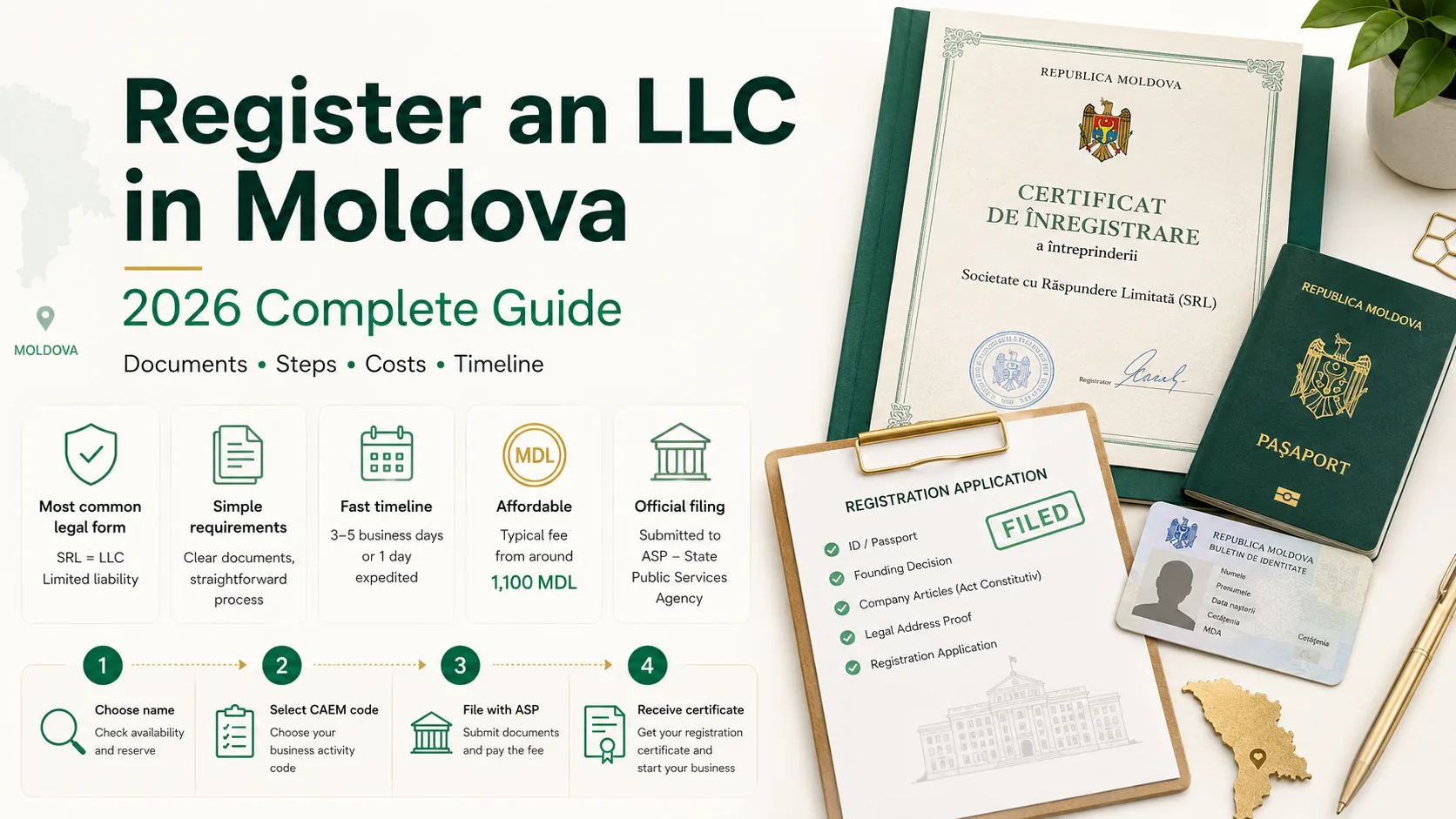
How to register an LLC in Moldova: required documents, steps, costs from 2,000 MDL, ~3-day timeline, share capital, and tax advantages. Full company formation guide.
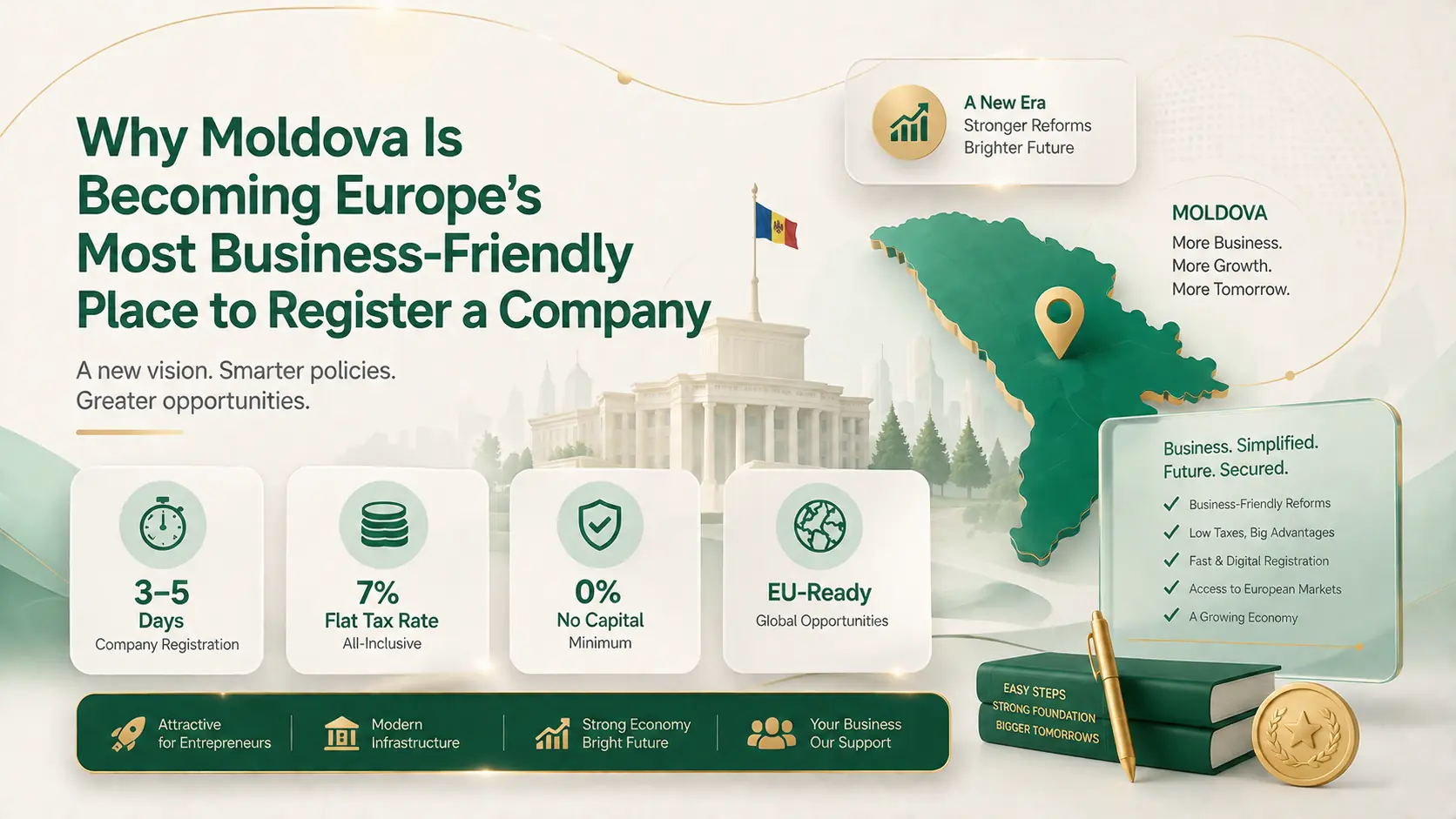
What Moldova's 2026 'European Economy, Efficient State' reform plan changes for registering a company — and why it is already a fast, remote-friendly place to start.
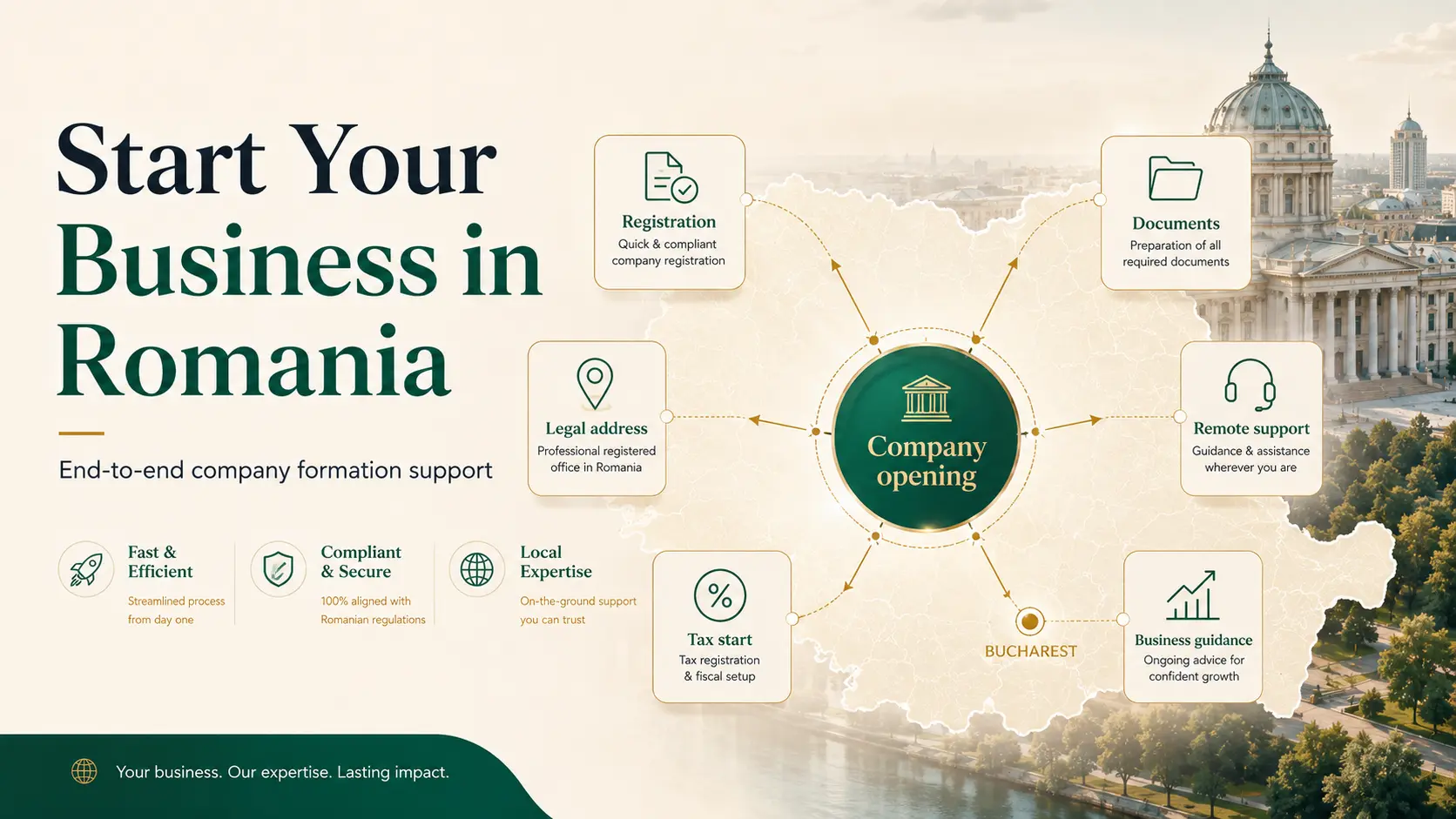
What a Romanian company actually adds, which reasons stopped being true in 2026, and what an SRL costs — whether you are starting out or already trading.