Complete Guide: How to Register an LLC in Moldova in 2026
How to register an LLC in Moldova: required documents, steps, costs from 2,000 MDL, ~3-day timeline, share capital, and tax advantages. Full company formation guide.
 DeschideCompanie
 Moldova's draft Pharmacy Law drops the 250 m rule, makes the authorisation open-ended and opens villages to networks. What it means for founders and investors.
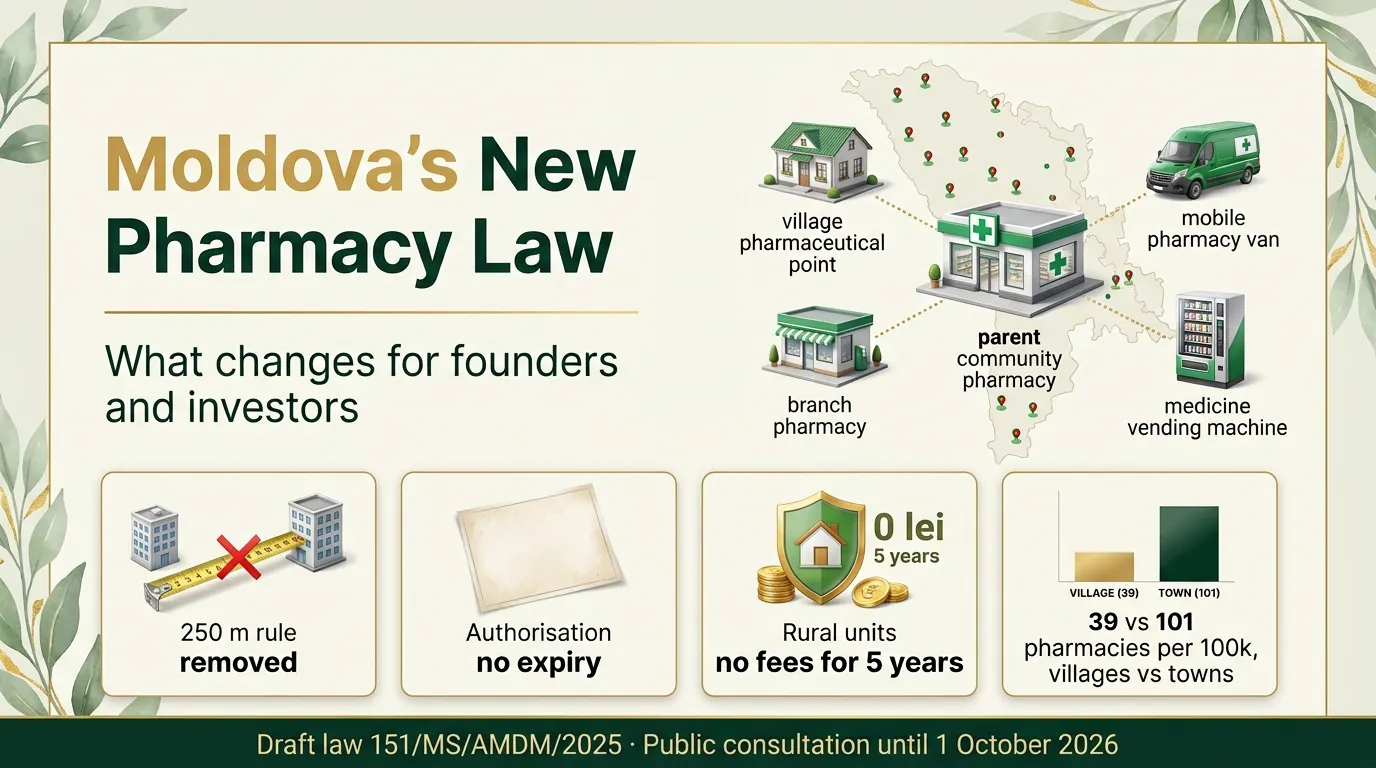
Pharmacies in Moldova still run under a law passed in 1993. The Ministry of Health wants to replace it, and the draft of the new Pharmacy Law, registered as no. 151/MS/AMDM/2025, is in public consultation until 1 October 2026. If it clears the Government and Parliament in its current form, it changes three things that matter to anyone thinking of opening a pharmacy: where you can open it, how long the permit you work under stays valid, and the ways you can reach customers in villages.
For now it is a draft, not a law. Below is what it proposes, what the rules look like today and what you can already do if you want a pharmacy.
The new Pharmacy Law is a draft prepared by the Ministry of Health together with the Medicines and Medical Devices Agency (AMDM), and it repeals Law no. 1456/1993 on pharmaceutical activity. Between 9 September and 1 October 2026 it is going through its fifth round of public consultation on particip.gov.md, where the draft text and its explanatory note are both published.
The first consultation took place in November 2024, so the text has already been rewritten several times. After this round it goes to the Government for approval and then to Parliament for a vote. The draft says the law takes effect three months after publication in the Official Gazette (Monitorul Oficial), but no publication date is known yet.
The main argument is geography. The Ministry of Health works from 2023 data: the country had 1,604 pharmacies and branches, 1,067 in towns and 537 in villages. Yet almost 56% of people live in villages. That works out to roughly 101 pharmaceutical units per 100,000 residents in towns and only 39 in villages.
The state has already tried to close the gap through the “Pharmacy in Your Village” programme, which opened 135 subsidised pharmacies serving about 180,000 people. The new law no longer relies on subsidies alone. It changes the rules so that an existing pharmacy can reach the villages around it more easily. “We don’t have to choose between a permanent pharmacy in every village and nothing,” said Health Minister Alexandru Gasnaș.
| What is regulated | Today’s rule | What the draft proposes | What it means for a new pharmacy |
|---|---|---|---|
| Distance from another pharmacy | At least 250 m, and 500 m from a pharmacy that compounds medicines | The rule no longer appears in the law | You choose premises for customers, not for neighbours |
| Population in towns | One pharmacy per 3,000–4,000 residents, proven with a certificate from the town hall | This norm no longer appears either | The town hall certificate drops out of the file |
| The permit you work under | Five-year licence | Authorisation with no expiry | No renewal every five years |
| Villages without a pharmacy | A pharmacy or a branch | Branch pharmacies, pharmaceutical points, mobile units and medicine vending machines | One authorised pharmacy can serve several villages |
Both rules in the first rows are written today in Article 19 of Law no. 1456/1993. The draft repeals the law without carrying them over, and puts a different limit in their place: village units can only be opened if the pharmacy responsible for them is within a road distance that allows supervision, supply and the pharmacist’s visits.
For villages without a pharmacy, the draft introduces the idea of a “parent” community pharmacy. Branch pharmacies, pharmaceutical points, mobile units and vending machines do not operate on their own. They report to the parent pharmacy, which carries professional responsibility for them. A coordinating pharmacist must be physically present at least two days a week and can supervise remotely the rest of the time. A pharmaceutical point can be staffed by a pharmacy assistant or by a health worker who has completed a nationally certified retraining programme. Health workers already working in rural pharmaceutical units get up to 24 months to complete that retraining.
A mobile pharmacy unit only serves villages with no pharmacy, branch or pharmaceutical point, on a route and timetable notified to AMDM. It does not compound medicines, does not dispense medicines containing narcotic or psychotropic substances or precursors, and must monitor temperature continuously. Mobile units run as a three-year pilot from the date the law takes effect, after which the Ministry decides whether to continue. Vending machines also start as a pilot and may only dispense over-the-counter medicines from a list set by ministerial order.
A few changes apply to every pharmacy, not just the ones in villages:
If you look at pharmacies as a business with several units rather than a single shop, the draft changes the numbers in a few concrete ways.
The market has room to grow exactly where it is thinnest today. Villages have 39 pharmaceutical units per 100,000 residents against 101 in towns, even though more than half the population lives there. The network is already growing: according to the explanatory note, the number of pharmacies and branches rose by about 16% between 2018 and 2023, from 1,384 to 1,604.
The limits that decided where you could open go away. With no 250-metre rule and no population norm, location becomes a commercial decision, and an authorisation with no expiry takes the five-year renewal out of the business plan.
A network becomes cheaper to extend into villages. Around a parent pharmacy you can run branches, pharmaceutical points and mobile units that no longer have to be full pharmacies with a pharmacist on site every day. For five years after the law takes effect, rural units pay no authorisation fees, and the law provides separate support mechanisms for village pharmacies.
The rules also move closer to the European Union’s. Online sales are regulated under the EU directive, and prescriptions from member states are recognised in Moldova. For an investor already working in the European market, that means fewer new rules to learn.
Two things still need to go into the calculation. The text can change before the vote, and every parent pharmacy must be run by a pharmacist in charge, so the plan needs people, not just capital. You can, however, own the company entirely from abroad and register it remotely by power of attorney, as explained in our guide for foreign founders.
Today’s rules apply until the new law takes effect, so a pharmacy opened this autumn respects the 250-metre distance and receives the five-year licence. The licence costs 3,250 lei, but only 1,625 lei if the company was registered no more than a year before the application. The order matters: company first, then licence.
The full route, with the AMDM licence, the town hall notifications and the right CAEM codes, is on our page about how to open a pharmacy in Moldova. If you are thinking of a network, the company you open now for a pharmacy in town is the same one that will be able to open branches and points in villages once the law allows it. The text can still change before the vote, so have the village plan ready but start it after the law is published.
We set the company up so you can apply for the licence straight away: the right legal form, usually an LLC (SRL), the founding documents, the CAEM code for retail sale of pharmaceutical products, a registered address, filing with the Public Services Agency, the bank account and, if the director comes from abroad, the IDNP personal number. Registration takes about three working days, and our services and prices are on the corporate services page.
Write to us with where you want to open the pharmacy or network, who will run it and whether you are investing from abroad, and we will tell you which documents you need for the company and for the licence. We will update this article when the draft reaches the Government.
It has no date yet. Draft no. 151/MS/AMDM/2025 is in public consultation until 1 October 2026, and must then be approved by the Government and passed by Parliament. Under the draft, the law takes effect three months after publication in the Official Gazette. Until then, pharmacies open under Law no. 1456/1993.
The 250-metre rule and the norm of one pharmacy per 3,000–4,000 residents in towns are set out today in Article 19 of Law no. 1456/1993. The draft repeals that law and does not carry them over. Until the draft is adopted, both rules still apply to every new pharmacy.
A unit of a community pharmacy with no legal personality of its own, located in a rural locality and allowed to dispense a limited range of medicines. It is staffed by a pharmacy assistant or a retrained health worker and coordinated by a pharmacist who, under the draft, must be physically present at least two days a week.
The draft replaces today's five-year licence with an authorisation for the activity of the pharmaceutical unit, issued for an unlimited period. Rural pharmaceutical units would pay no authorisation fees for five years after the law takes effect.
Yes. A foreign investor can own 100% of a Moldovan LLC (SRL) and register it by power of attorney without travelling to Moldova. Each pharmacy must still be run by a pharmacist and needs a licence from AMDM. If the new law is adopted, the same company will be able to open branches, pharmaceutical points and mobile units in villages around a parent pharmacy.
Yes, under today's rules: a registered company, premises, a pharmacist in charge and a licence from the Medicines and Medical Devices Agency. If you apply for the licence within a year of registering the company, the fee is 1,625 lei instead of 3,250.
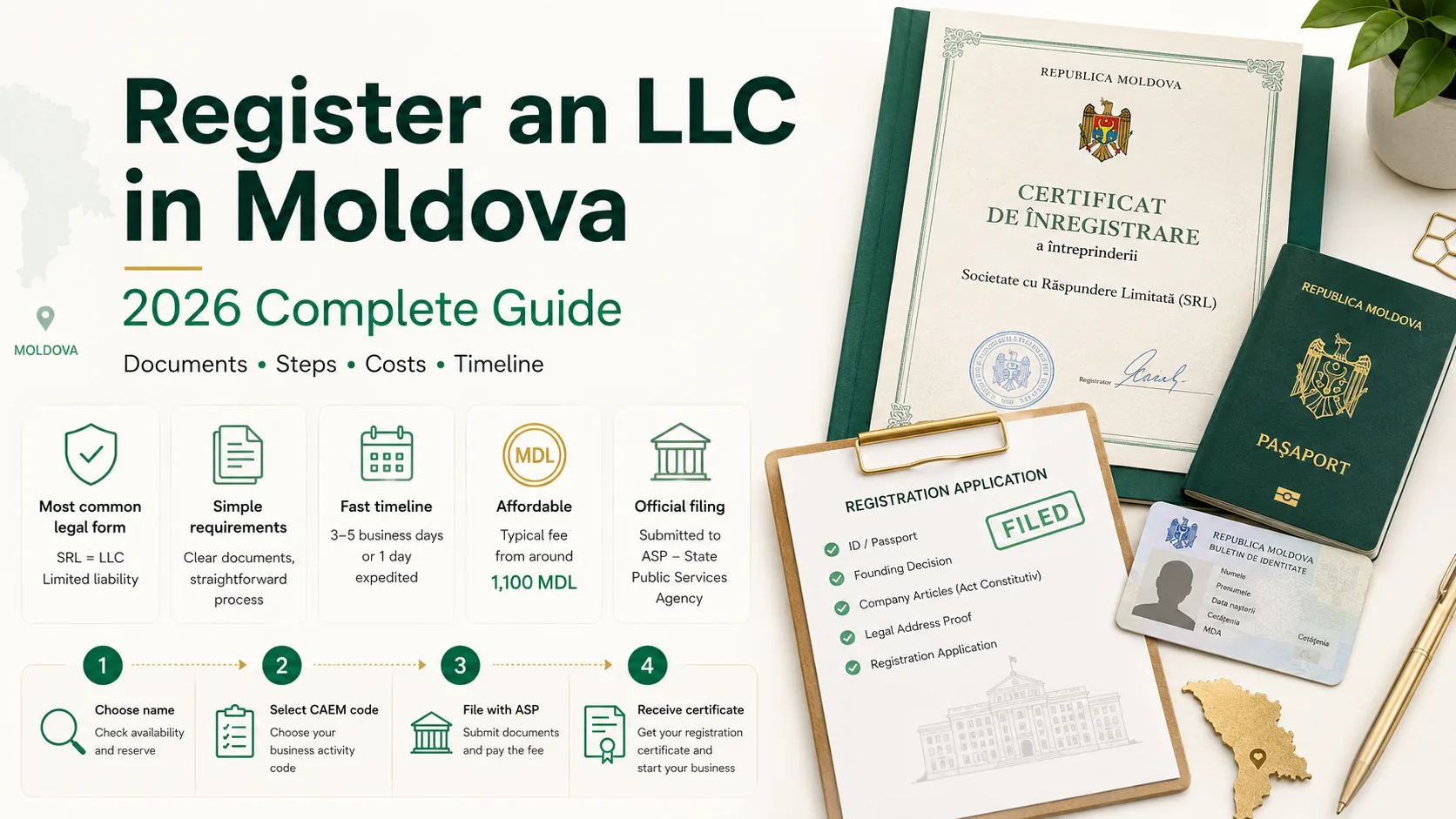
How to register an LLC in Moldova: required documents, steps, costs from 2,000 MDL, ~3-day timeline, share capital, and tax advantages. Full company formation guide.

What Moldova's 2026 'European Economy, Efficient State' reform plan changes for registering a company — and why it is already a fast, remote-friendly place to start.
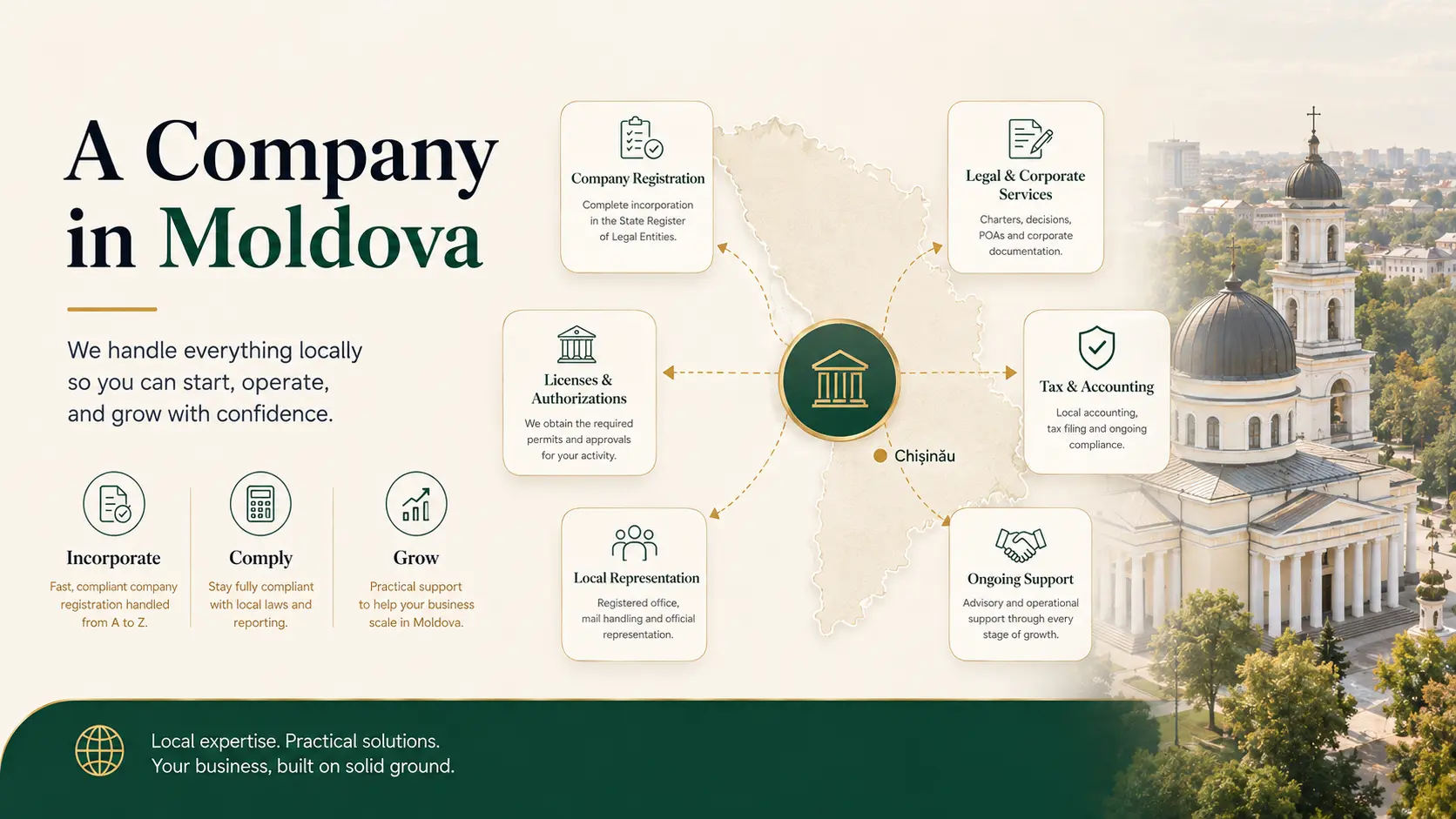
What a Moldovan company gives a Romanian founder, what registering one involves — no apostille, a notarised power of attorney is enough — and what it does not solve.