Complete Guide: How to Register an LLC in Moldova in 2026
How to register an LLC in Moldova: required documents, steps, costs from 2,000 MDL, ~3-day timeline, share capital, and tax advantages. Full company formation guide.
 DeschideCompanie
 The 50-hectare tech campus in Stăuceni: the masterplan, when building starts, how it differs from Moldova IT Park and what an IT company can do today.
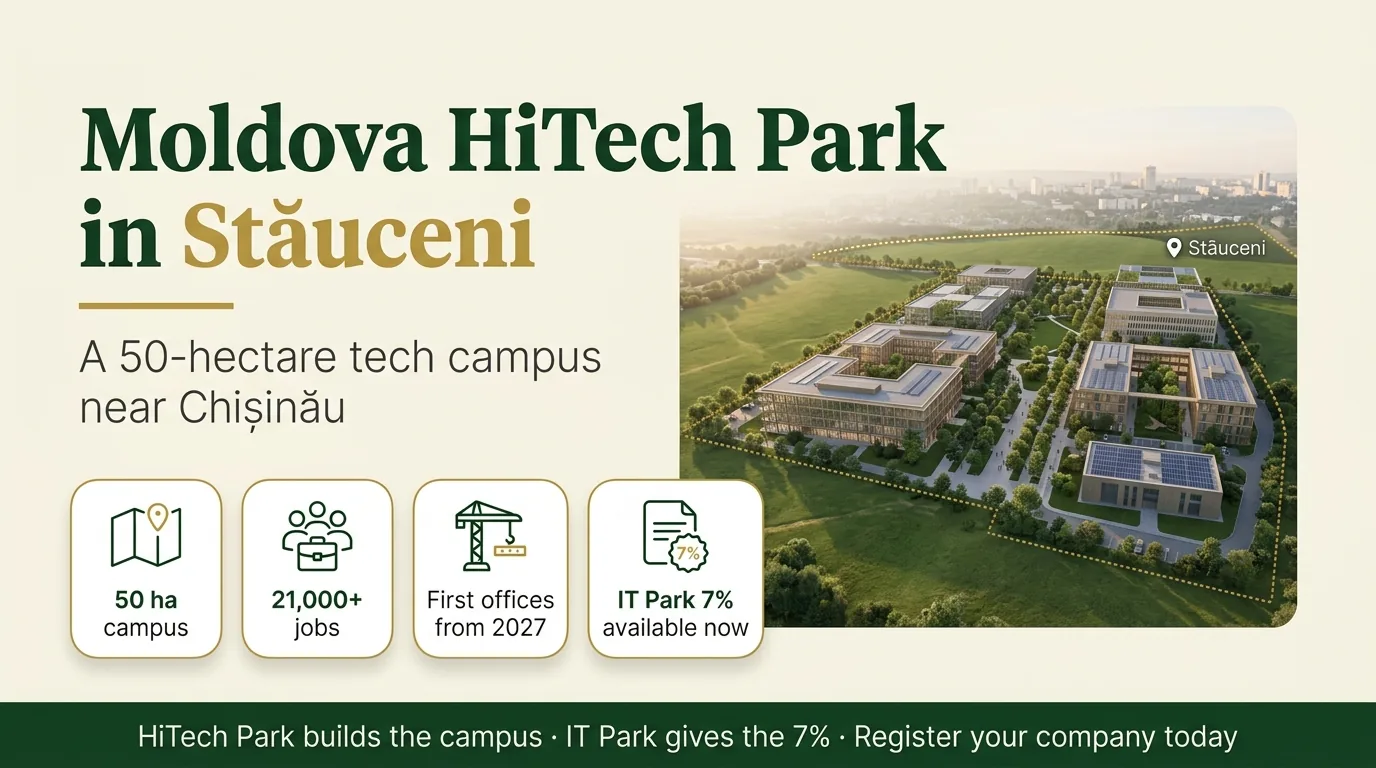
Moldova HiTech Park is the technology campus the state is building in Stăuceni, on the northern edge of Chișinău, next to Arena Chișinău. About 50 hectares of public land will hold tech companies, two universities, labs, a data centre and housing. The park was created by Law No. 206/2025, and in August 2026 it got its masterplan.
For a founder the practical question is a different one: what the campus means for their company, and what they can do today, years before the first building is finished. Below are the masterplan figures, the phases, the route to residency, and the difference between HiTech Park and Moldova IT Park, which people mix up all the time.
Law No. 206/2025, passed on 10 July 2025, sets up a special regime for creating and running the Moldova HiTech Park Advanced Technology Park. The park is designed as a small town: offices, labs, university campuses, a conference centre, testing and prototyping facilities, and housing.
The park is run by a company, Moldova HiTech Park SRL, owned by public and academic shareholders:
| Founder | Share |
|---|---|
| Public Property Agency (the state) | 55% |
| Chișinău Municipal Council | 15% |
| Stăuceni Town Council | 15% |
| Technical University of Moldova | 7.5% |
| Nicolae Testemițanu State University of Medicine and Pharmacy | 7.5% |
In autumn 2025 the Government granted the company Category B industrial park status under Law No. 182/2010 on industrial parks. It is the second industrial and technology park of its kind in the country. That status sets out what the operator can do: it allocates land to residents under a lease or a building right (superficies) and signs the contracts with them, while residents get the incentives available in industrial parks.
The masterplan presented on 13 August 2026 was drawn up by the Romanian practice UNITH2B together with Architects Group from Chișinău, with funding from the German Government through GIZ. Its headline figures:
| Indicator | Masterplan |
|---|---|
| Area | about 50 hectares of public land |
| Built space | more than 600,000 m² |
| Green and public space | at least 40% of the site |
| Jobs | more than 21,000 skilled jobs |
| MedTech and HealthTech zone | 22% of the area |
| Project horizon | 30 years, with an extension to 50 proposed |
The campus has six focus areas: HealthTech, DeepTech, AgriTech, cybersecurity, EnergyTech and the creative industries (CreaTech). Alongside them come a GovTech cluster with a data centre, high-tech manufacturing, Class A offices and coworking space. The medical side already has a partner: in June 2026 the park and the European Commission agreed to build a MedTech cluster together, with the aim of training 15,000 specialists by 2036.
“Moldova cannot compete on size, but it can compete on talent, collaboration and speed,” Doina Nistor, president of the park’s Council, said at the presentation.
The next legislative step came on 2 October 2026. Parliament passed at first reading, with 55 votes, a bill declaring the park’s construction works of public utility: the roads, power lines, sewerage and access routes. The same bill extends the park’s operating period from 30 to 50 years. It still needs a second reading before it takes effect.
For investors, public utility and the 50 years matter more than they might seem. The first speeds up the utilities every building depends on. The second gives a longer horizon for the land contracts the operator signs with residents.
The timeline on the park’s website splits construction into four phases after a preparatory one:
| Phase | Period | What happens |
|---|---|---|
| 0 | 2024–2026 | The special law, the regulatory framework, feasibility studies |
| 1 | 2025–2027 | Core infrastructure: roads, utilities, energy, connectivity, the first anchor investors |
| 2 | 2027–2029 | Offices, research labs, university facilities, MedTech infrastructure |
| 3 | 2029–2031 | High-tech manufacturing, start-up scale-up, the data centre |
| 4 | 2031–2035 | International tenants, IP commercialisation, a mature park |
The immediate step is the Zonal Urban Plan, with approval targeted for spring 2027. The first call for expressions of interest covers Phase 1, for 2026–2029, and is aimed at companies that want to be among the first residents.
The names are close, and the park’s website lists the “7% IT regime” among its advantages, so the two are easy to confuse. They are still different instruments, created by different laws.
| Moldova IT Park | Moldova HiTech Park | |
|---|---|---|
| Law | Law No. 77/2016 | Law No. 206/2025 and Law No. 182/2010 |
| Form | Virtual park, no territory | Physical campus of about 50 ha in Stăuceni |
| What the company gets | 7% single tax on sales revenue | Land, offices, labs, industrial park incentives |
| Who can join | Companies with IT activities listed in Article 8 | Companies in the six focus areas or related technologies |
| Registered office | Anywhere in Moldova | On the campus |
| Available | Now | Phase by phase, from 2027 |
In short, the 7% tax comes from IT Park, not HiTech Park. A software company that moves to Stăuceni can be a resident of both parks, each for its own purpose. An AgriTech company that builds equipment can join HiTech Park without qualifying for 7%, because the IT Park regime is granted by CAEM class, not by field.
Moldova IT Park already has 2,665 residents, 343 of them with foreign capital from 44 countries, and in December 2025 the Ministry of Economic Development and Digitalisation announced that their tax regime will stay unchanged until 2035. Who qualifies, how to apply and the minimum tax per employee are covered in the Moldova IT Park guide, and you can work out the monthly amount in the IT Park calculator.
The park describes a five-step route: application, eligibility review, board approval, residency agreement and onboarding onto the campus. The basic test is that the company works in one of the park’s focus areas or a related technology and has a credible plan for research, hiring or commercialisation.
What the park offers, in its own words: access to the tax regime, infrastructure, links with the universities and their joint programmes, and contact with investors. For companies that need their own space, the operator can grant land under a lease or superficies for labs, private campuses or manufacturing. The actual contract terms, including price and duration, are negotiated with the operator.
Whatever the arrangement, the residency agreement is signed with a company registered in Moldova. A foreign investor cannot join the park directly, as an individual or through a parent company abroad. They need an SRL or a branch here.
The first offices come in Phase 2, after 2027. The company, its bank account, its track record and, if it qualifies, its IT Park residency can all be in place from tomorrow. A company that answers the call for expressions of interest with two years of activity, staff and contracts has a stronger application than one registered the week it applies.
The practical order:
For a software or IT services company, the obligations from registration to the first hire are on the page about how to open an IT company in Moldova. If the founder is based abroad, the specific steps are in the guide for foreign founders.
We set the company up so it can apply to IT Park straight away and to HiTech Park when the right phase opens: the legal form, usually an LLC (SRL), the founding documents, CAEM codes eligible for the 7% regime, a registered address, filing with the Public Services Agency, the bank account and the IDNP personal number for founders and directors from abroad. Once the company is registered, we help with the IT Park residency application. Registration takes about three working days, and our services and prices are on the corporate services page.
Write to us with what your company does, which of the park’s focus areas it fits and whether you are investing from abroad, and we will tell you which CAEM codes you need and whether you qualify for 7%.
A technology campus of about 50 hectares in Stăuceni, just outside Chișinău, created by Law No. 206/2025. It will bring together technology companies, universities, research labs and start-ups. The park is run by Moldova HiTech Park SRL and holds Category B industrial park status.
No. Moldova IT Park is a virtual park, created by Law No. 77/2016, that gives the 7% single tax to companies with eligible IT activities, wherever their registered office is. Moldova HiTech Park is a physical campus in Stăuceni with industrial park status. An IT company can hold both: IT Park residency for the tax regime and HiTech Park residency for land, offices and labs.
The masterplan was presented in August 2026, and the Zonal Urban Plan is due for approval in spring 2027. The park's timeline has core infrastructure by 2027, offices and labs between 2027 and 2029, manufacturing and the data centre between 2029 and 2031, and a mature park by 2035.
Companies working in the park's fields, namely HealthTech, DeepTech, AgriTech, cybersecurity, EnergyTech and the creative industries, or in related technologies, with a credible plan for research, hiring or commercialisation. Applications go through an eligibility review and board approval, followed by a residency agreement.
No. The 7% single tax comes with Moldova IT Park residency, not with HiTech Park. If your company's activity is on the list in Article 8 of Law No. 77/2016, you can become an IT Park resident now, with a registered office anywhere in Moldova. The Ministry has announced that the regime will stay in place until 2035.
About 50 hectares of public land in Stăuceni, more than 600,000 m² of built space, and at least 40% of the site kept as green and public space. The masterplan projects more than 21,000 skilled jobs.
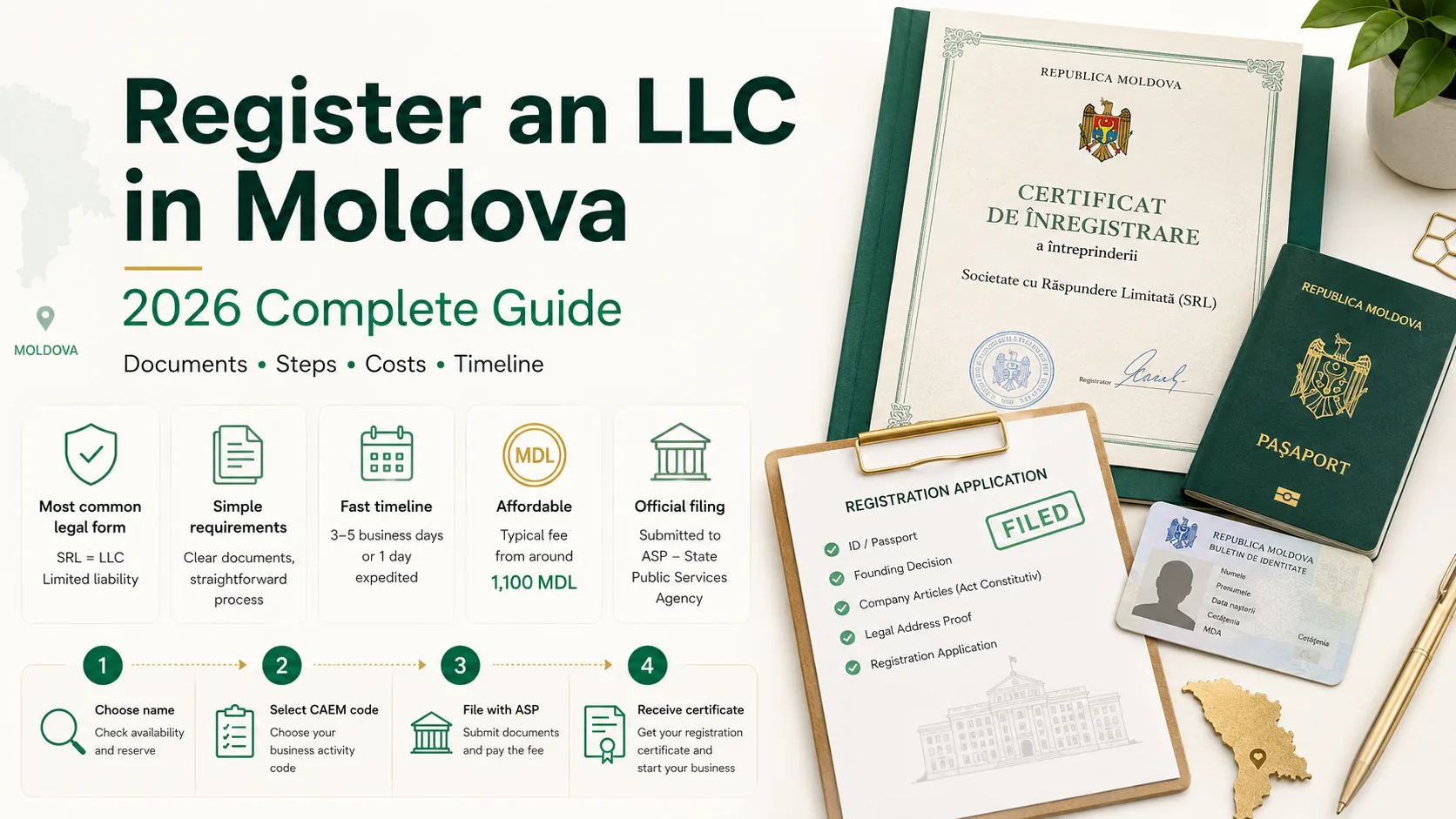
How to register an LLC in Moldova: required documents, steps, costs from 2,000 MDL, ~3-day timeline, share capital, and tax advantages. Full company formation guide.
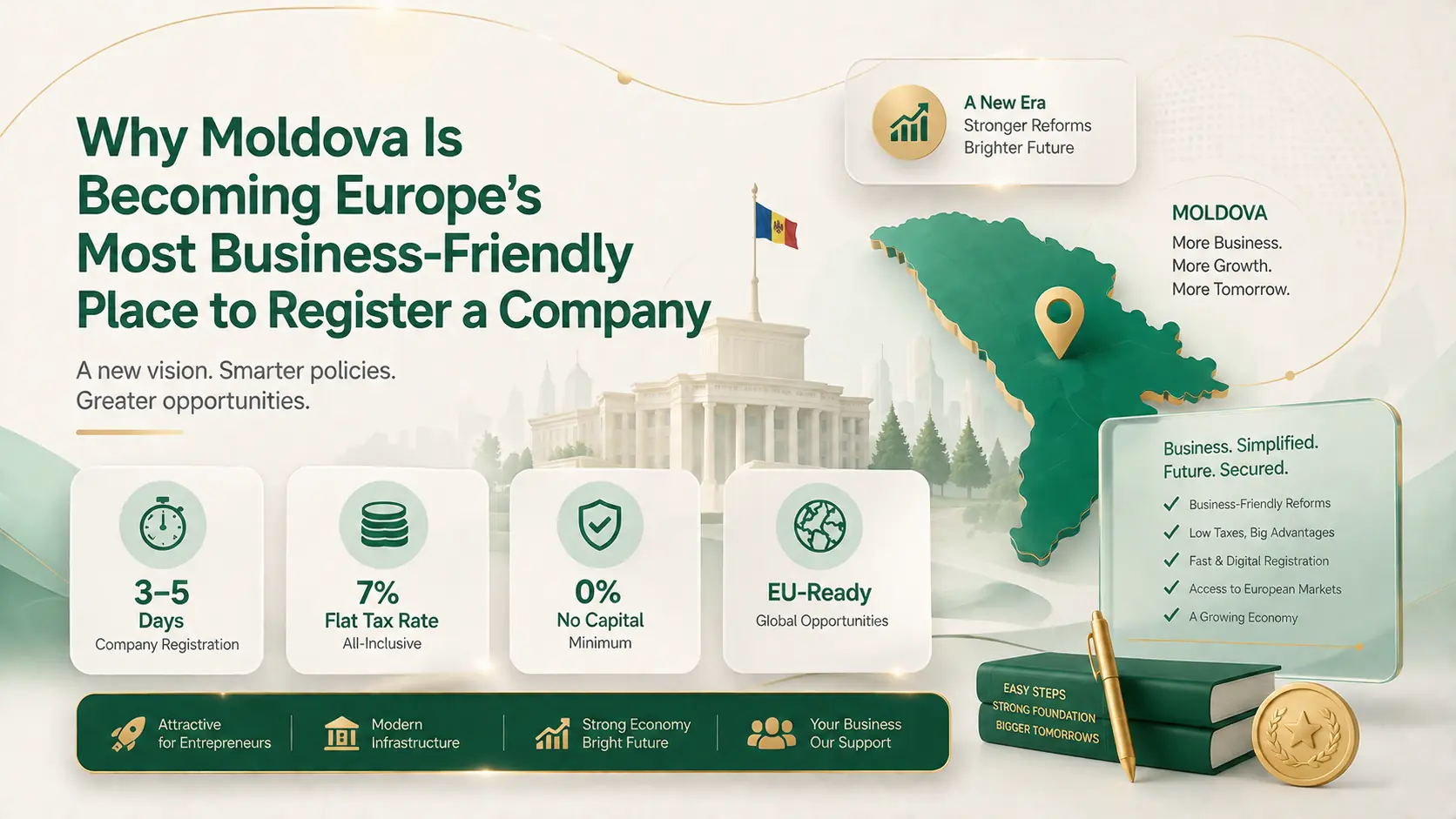
What Moldova's 2026 'European Economy, Efficient State' reform plan changes for registering a company — and why it is already a fast, remote-friendly place to start.
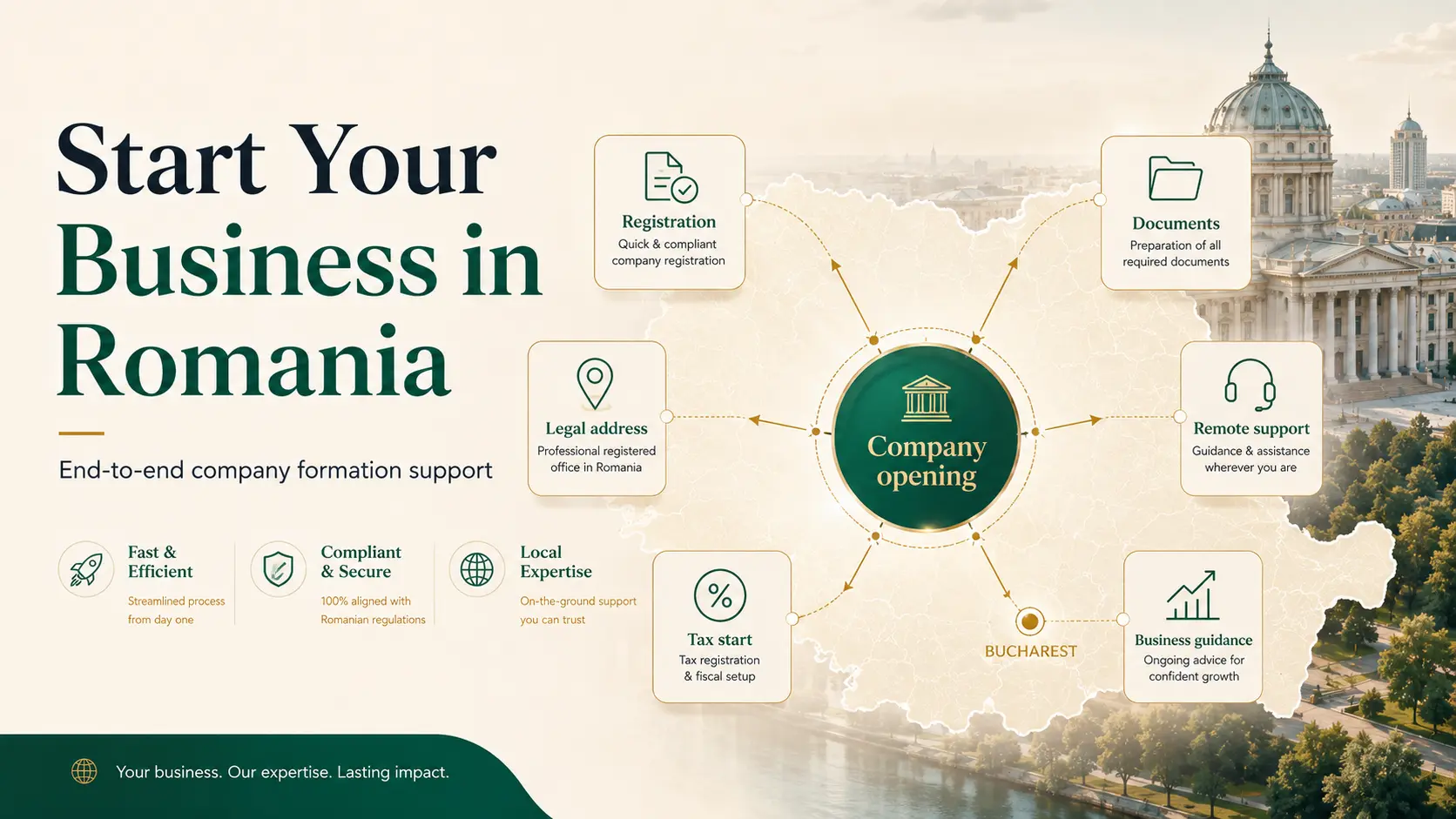
What a Romanian company actually adds, which reasons stopped being true in 2026, and what an SRL costs — whether you are starting out or already trading.